
No Official Online Warrant List in Osceola County
There is no county website where you can type a name and pull up an active Osceola County warrant. Official county sources do not host a warrant portal, a most-wanted page, or a warrant amnesty program. Search results that promise an "Osceola County warrant lookup" often point to Florida or Iowa counties with the same name, or to paid data brokers. Those are not the record. A real answer comes only from the Michigan court that signed the warrant or the law enforcement agency holding it.
Because no database exists, an Osceola County warrant search runs on a short chain of direct contacts. Each step points to an office that actually keeps warrant information for local cases.
- The 77th District Court for bench warrants and missed court dates.
- The 49th Circuit Court for felony matters after a case moves up.
- The Osceola County Sheriff by phone or in person.
- The Prosecuting Attorney for charging context on a new case.
Statewide tools help around the edges. The MiCOURT case search may show public case events for participating courts, and it can confirm a hearing or a case number. It is not a live warrant status screen, so any hit still needs a call to the court or the sheriff to confirm.
Note: Never treat a third-party "warrant check" website as proof, since only the issuing court or the sheriff can confirm whether an Osceola County warrant is active today.
Who Issues Osceola County Warrants
Warrants in Osceola County start inside the court system. In the 77th District Court, magistrates may set bail, accept bond, and issue arrest and search warrants authorized by the prosecutor or a municipal attorney. That authority is why so many local warrants trace back to the district court rather than the higher trial court.
The Prosecuting Attorney, Anthony Badovinac, holds criminal jurisdiction for state felonies and misdemeanors across the county. Prosecutors review police reports and authorize the charges that support an arrest warrant. A judge or magistrate then signs the order. The prosecutor's office can explain charging context, but it does not clear warrants or give legal advice to the person named.
Felony cases begin with a district court arraignment and preliminary examination. Once a felony is bound over, the 49th Circuit Court takes the case, and post-bindover bench warrants can show up in circuit records. Judges and magistrates sign warrants; the sheriff and police serve them.
Check the 77th District Court for Warrants
The 77th District Court is the first stop for most Osceola County warrant questions. This court handles misdemeanors, felony arraignments and preliminary exams, traffic cases, small claims, and landlord-tenant matters. Bench warrants issued here usually follow a missed court date, an unpaid fine, or a traffic failure to appear. Because the district court touches more residents than any other court, its bench warrants are the most common kind people run into.
The 77th District Court routes calls by case type, so knowing your division saves a transfer. The criminal clerk answers at (231) 832-6155, option 1. The traffic clerk takes option 3, and the civil clerk takes option 2. Ask the clerk whether a bench warrant is showing, whether bond is set, and whether you can schedule a new hearing. The court sits at 301 W. Upton Avenue in Reed City, in the lower level of the Main Courthouse.
The district court's own department page lists its judge, magistrate, division clerks, and e-filing notices. You can review the 77th District Court page before you call to confirm contacts and hours.
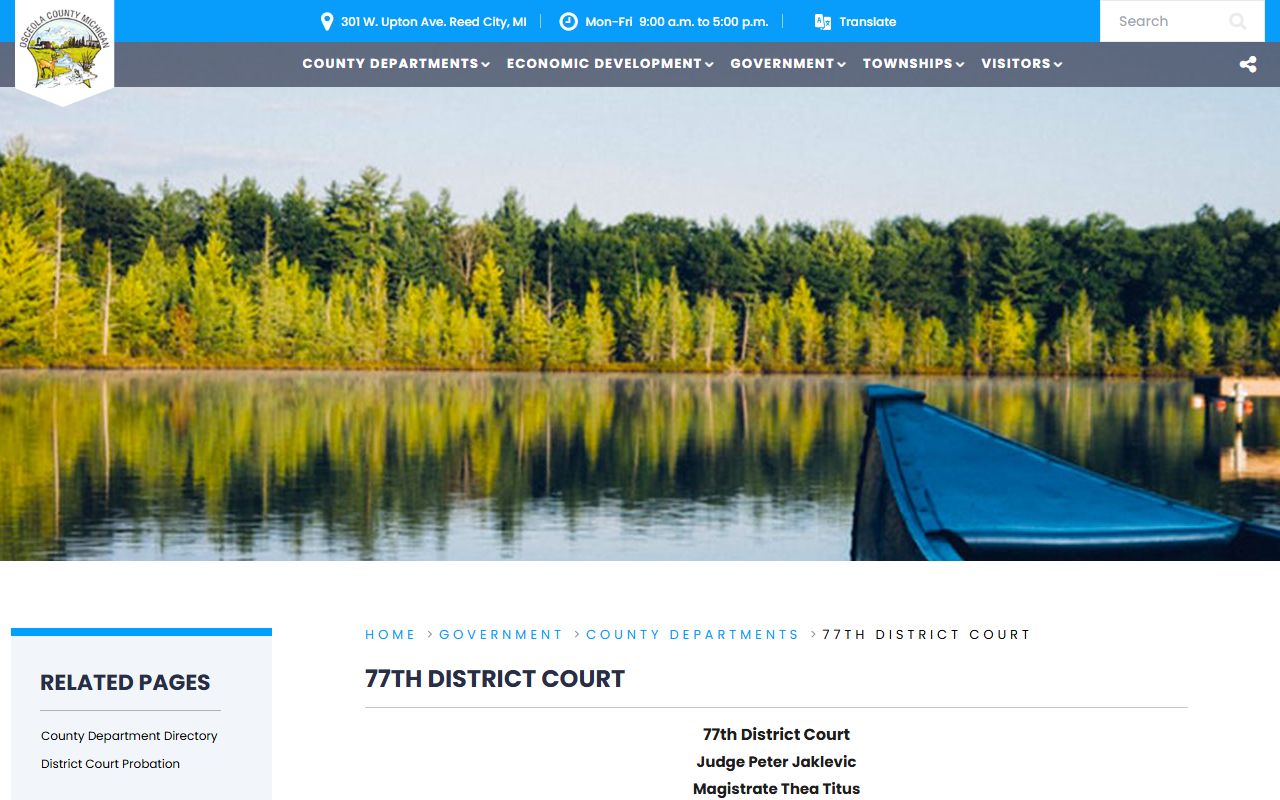
The page above shows the criminal, traffic, and civil division contacts that handle most Osceola County bench warrant questions. Matching your case to the right division clerk gets you a straight answer faster.
Felony Warrants and the 49th Circuit Court
Felony warrants can move with the case. A felony starts in the district court for arraignment, bond, and a preliminary exam. If the judge binds the case over, it proceeds to the 49th Circuit Court, which Osceola shares with Mecosta County. Bench warrants tied to a felony can then appear in circuit court records instead of district court records.
Circuit filings and searches run through the County Clerk counter for the 49th Circuit Court. The clerk performs a paid name search for circuit criminal and civil records, which can surface an underlying case even when a warrant itself is not posted online. For the full criminal file, charges, pleas, and sentence, see the county criminal court records. To confirm a felony warrant, call the circuit court at (231) 832-3261 or ask the County Clerk which court holds the case.
Confirm an Osceola County Warrant With the Sheriff
The Osceola County Sheriff's Department serves warrants and can tell you whether one is active. When court staff cannot confirm a warrant over the phone, the sheriff is the practical fallback. The department provides law enforcement, corrections, and court services, and it can be reached at the main line during business hours.
Sheriff Mark Cool leads the department at 325 W. Upton Avenue in Reed City, next to the Main Courthouse. Walk-in services such as pistol permits, sex offender registry updates, and non-court fingerprinting run on weekday afternoons, and staff ask that you bring valid identification. Call before visiting so you reach the right person for a warrant question.
Osceola County Sheriff's Department
Sheriff: Mark Cool
325 W. Upton Avenue
Reed City, MI 49677
(231) 832-2288
Emergency: 911
Walk-in services: Monday to Friday, 9:00 a.m. to 4:00 p.m.
You can review the department's services on the official Sheriff's Department page. If the person is already booked into the jail, the county has no online roster, so an inmate lookup also starts with this same phone number.
Information to Have Ready Before You Call
A warrant check goes faster when you can answer the clerk's first questions. Since there is no online form to fill in, the court or sheriff staff will ask for identifying details by phone or at the counter. Gather these items before you contact any office so a common name does not slow the search.
| Detail to Have Ready | Why It Helps |
|---|---|
| Full legal name | Matches the person named on the warrant, including middle name and any suffix. |
| Date of birth | Separates people who share the same or a similar name. |
| Case number, if known | Uses the Michigan year prefix and two-letter case-type suffix to find the file fast. |
| Which court | Tells staff whether to check district, circuit, or another court. |
| Charge or reason | Points to the underlying ticket, missed date, or offense behind the warrant. |
Give the operator the case type as well, since criminal, traffic, and civil matters route to different clerks. The more precise your details, the less the office has to guess.
Why ICHAT Is Not an Osceola County Warrant Search
Many people try the Michigan State Police ICHAT system as a shortcut. ICHAT is a real statewide criminal-history tool, but it is the wrong tool for warrants. The State Police state plainly that warrant information and suppressed records are not available through ICHAT. A clean ICHAT result does not mean no warrant exists.
ICHAT reports public conviction history maintained in the state repository. It is useful for background checks and for confirming past cases. It does not show pending charges, live warrant status, or county jail custody. To confirm a warrant, the request must go to the issuing court or the sheriff, not to a criminal-history database. You can read the scope of the search on the Michigan State Police ICHAT page.
The MDOC OTIS system has the same limit for warrants. OTIS lists sentenced state prisoners, parolees, and probationers, not people with an open warrant. Neither statewide tool replaces a call to the local court.
Types of Osceola County Warrants
Not every warrant is an arrest warrant. Osceola County cases can generate several kinds, and the type shapes how you resolve it. A traffic failure to appear clears very differently from a felony arrest warrant. The categories below cover what shows up most often in district and circuit records.
- Arrest warrant. A court order, authorized by the prosecutor and signed by a judge or magistrate, that directs police to arrest a named person.
- Bench warrant. Issued by a judge, most often for failure to appear at a hearing or for contempt of court.
- Search warrant. An order allowing officers to search a place or item for evidence, signed after the prosecutor authorizes the request.
- Failure to appear or failure to pay. A bench warrant tied to a missed court date or an unpaid fine, common in traffic and misdemeanor cases.
- Probation violation warrant. Issued when the court finds a person may have broken the terms of a probation sentence.
Some of these warrants carry a preset bond, and others require a hearing before release. The charge or reason behind the warrant, along with the arrest and booking side of the record, ties into the county arrest records and charges.
What an Osceola County Warrant Record Shows
When a court or the sheriff confirms a warrant, the record carries a standard set of details. No county portal displays these fields online, so staff read them from the court file or law enforcement system. Knowing the fields in advance helps you ask focused questions and understand the answer you get.
| Field | What It Shows |
|---|---|
| Person name | The individual the warrant is issued against. |
| Case number | The Michigan case number with a year prefix and case-type suffix. |
| Issuing court | The 77th District Court or the 49th Circuit Court. |
| Warrant type | Arrest, bench, search, probation violation, failure to appear, failure to pay, or contempt. |
| Charge or statute | The offense or the underlying case behind the warrant. |
| Bond amount or type | The bond set, or a no-bond status if release is not allowed. |
| Issue date | The date the court signed the warrant. |
| Service or return status | Whether the warrant is still open or has been served. |
| Next hearing or contact | The next court date or the office to call about the case. |
| Holds or detainers | Any hold lodged after an arrest, such as by another agency. |
Not every field is public in every case. Court rules protect certain personal identifiers, and some juvenile or sealed matters stay out of view entirely.
Resolving an Outstanding Osceola County Warrant
An open warrant does not go away on its own, and it can lead to an arrest during a routine traffic stop. The safer route is to confirm the warrant, learn the bond, and plan how to appear. The steps below follow the local structure, from the district clerk to the sheriff.
- Skip the third-party warrant sites and go straight to the sheriff or the court that holds the case.
- For a district criminal or traffic matter, call the 77th District Court criminal clerk at option 1 or the traffic clerk at option 3.
- For a felony or circuit matter, contact the County Clerk or the 49th Circuit Court, and strongly consider a defense attorney.
- Ask whether bond is set, whether a walk-in arraignment is possible, and whether a payment or new hearing will clear the issue.
- If surrender is required, coordinate with the sheriff or jail at 325 W. Upton Avenue, or work through your attorney.
- After the case is handled, ask the court how quickly the warrant recall clears from court and law enforcement systems.
Important: Talk with a criminal defense lawyer before you surrender on any warrant, since bond, charges, and your appearance strategy can change the outcome of the case.
App and Most-Wanted Warrant Status
Osceola County has no confirmed online most-wanted list or app-based warrant search. In February 2026, local news reported that the county board approved a three-year contract for a mobile app called SHERIFFapp, built by OCV LLC. Reported features included push notifications, inmate searches, anonymous tips, bail and commissary payments, and a local sex offender list.
None of those features has been verified as live for Osceola County. The reporting describes an approved and planned tool, not a working warrant lookup. Until the county publishes an official app link and confirms the features, treat any app-based warrant search as unconfirmed. For now, the phone-and-court path remains the reliable way to check an Osceola County warrant.
Restricted Osceola County Warrant Records
Some warrant information is not open to the public at all. Sealed warrants, such as an unserved arrest or search warrant, may stay confidential so a suspect is not tipped off before service. Michigan court rules also protect personal identifiers like date of birth, Social Security number, and driver's license number inside public filings.
Juvenile warrants follow stricter rules. Records of juvenile cases handled by the Probate and Family Court are open only by court order under state law, so a juvenile warrant is generally not a public record. Anyone seeking access should ask the court whether they qualify rather than assume the file is open.
Federal warrants sit in a separate system entirely. A federal arrest warrant or indictment out of the U.S. District Court for the Western District of Michigan does not appear in county court records. Federal case information runs through PACER and the federal courts, and the U.S. Marshals handle federal fugitive matters.
Federal court records for Michigan cases are reached through the PACER system, as explained on the federal court records page for the Eastern District of Michigan.
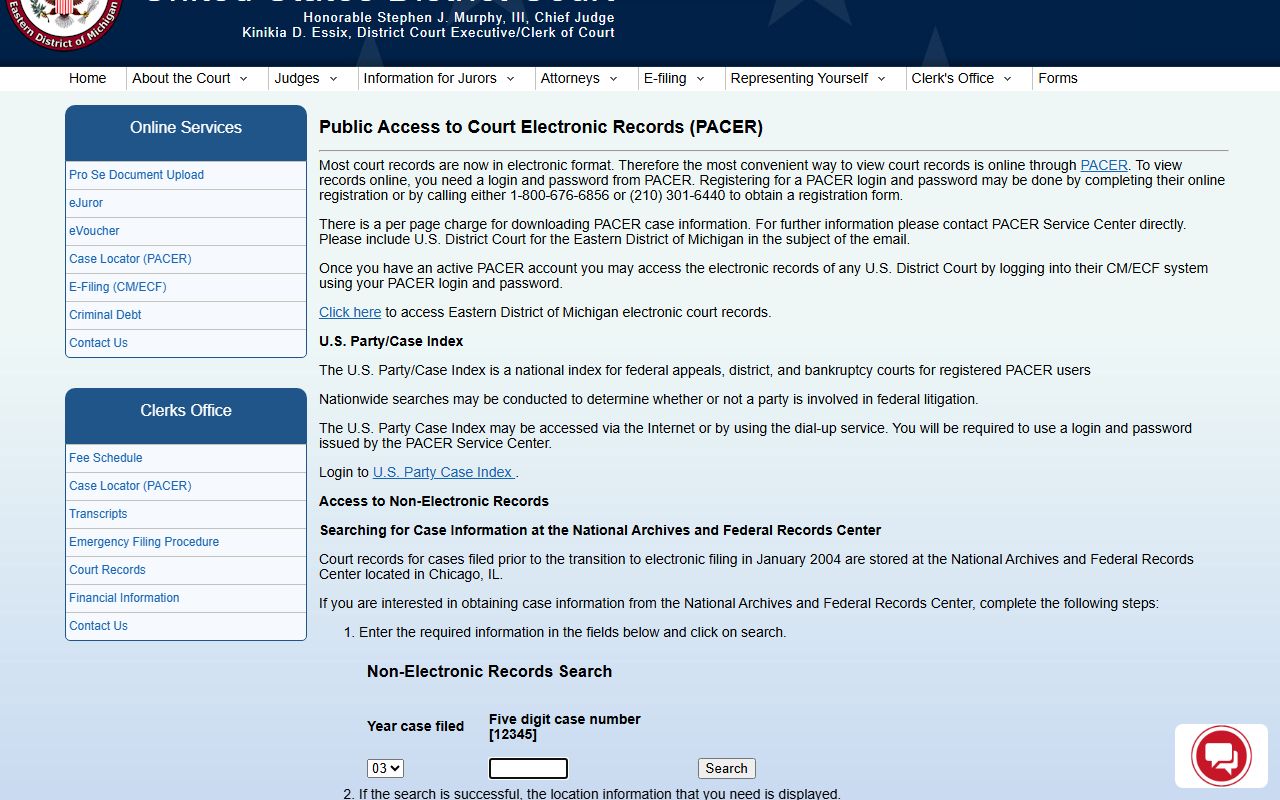
The federal court records guidance above applies when a warrant is federal rather than a local Osceola County matter. County courts and the sheriff cannot confirm or clear a federal warrant, so those go through the federal system.