
About the Osceola County Clerk's Office
Tracey Cochran serves as the Osceola County Clerk. In Michigan, the County Clerk is one of the elected county offices, and the clerk carries duties tied to both the courts and county government. The office sits on the first floor of the Osceola County Main Courthouse in Reed City. Staff there help residents with vital records, court filings, and a range of public documents each business day.
The clerk works closely with the 49th Circuit Court, which Osceola shares with Mecosta County. When a person files a divorce, a large civil claim, or a motion, the paperwork and fees usually pass through this office. A small team supports the clerk, including Emberly Babcock, Chief Deputy Clerk; Terri Van Belzen, Deputy Clerk; Amy Kitchen, Assistant Clerk; and Breanne Hill, Deputy Clerk. The county website lays out the office contact details and the records it maintains. Reviewing the official Osceola County Clerk page is a smart first step before any visit or mailed request.
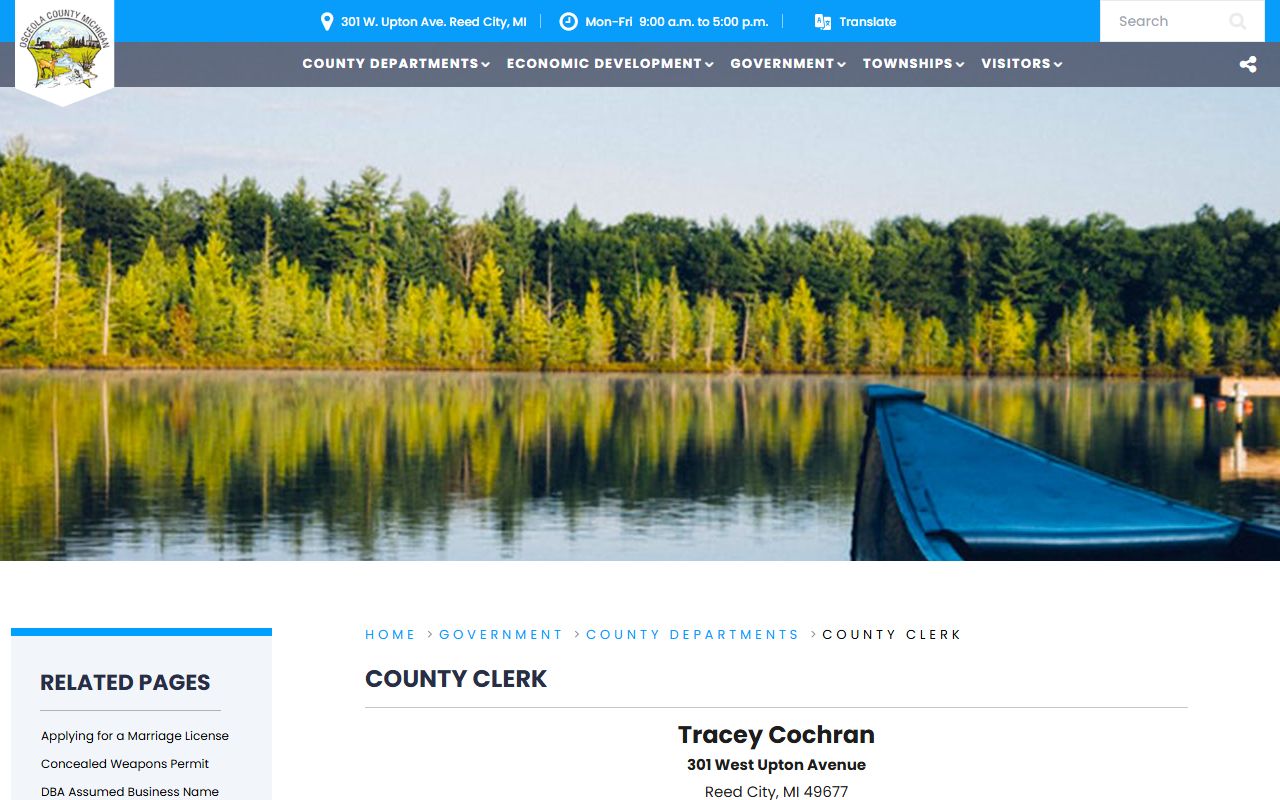
That page names the current staff and lists the birth, marriage, and death records the office holds, so it is worth a look before you call. The contact card below gathers the address, phone, fax, email, and hours in one place.
Osceola County Clerk
Clerk: Tracey Cochran
301 West Upton Avenue
Reed City, MI 49677
(231) 832-3261
Fax: (231) 832-6149
clerk@osceolacountymi.gov
Monday to Friday, 8:30 a.m. to 5:00 p.m.
Records the Osceola County Clerk Keeps
The Osceola County Clerk handles a wide mix of records and duties. Some are vital records that prove a life event. Others are court filings, business filings, or permits. The office also accepts certain fees for the 49th Circuit Court and performs paid name searches on request. Because the range is broad, it helps to know the main categories before you reach out.
- Birth, marriage, and death records, plus marriage license applications
- Assumed business names, also called a DBA, and concealed weapons permits
- Public meeting minutes, voter registration records, and veteran discharge records
- Custody and support filings, motion fees for the 49th Circuit Court, and personal protection orders
- New case filings for divorce and civil claims over $25,000, plus criminal and civil name searches
Land records are the one big category the clerk does not keep. Deeds, mortgages, and other real-property documents belong to the separate Register of Deeds, covered later on this page. For court dockets and case files, the office points people to the Osceola County Circuit Court process and to statewide search tools. Vital-record certificates, by contrast, come straight from the clerk.
Osceola County Vital Records and Online Orders
Certified vital records are among the most requested items at the counter. A certified copy of a birth, death, or marriage record carries the county seal and works for legal, travel, and benefit needs. The Osceola County Clerk issues these for events recorded in the county. Uncertified printouts do not carry the same weight, so most agencies ask for the certified version.
The county also offers online ordering for people who cannot come in person. The official Osceola County vital records page explains that certified copies of county birth, death, marriage, or judgment of divorce records may be ordered online. Orders are processed daily and mailed by USPS First Class Mail, or by Federal Express for an added charge.
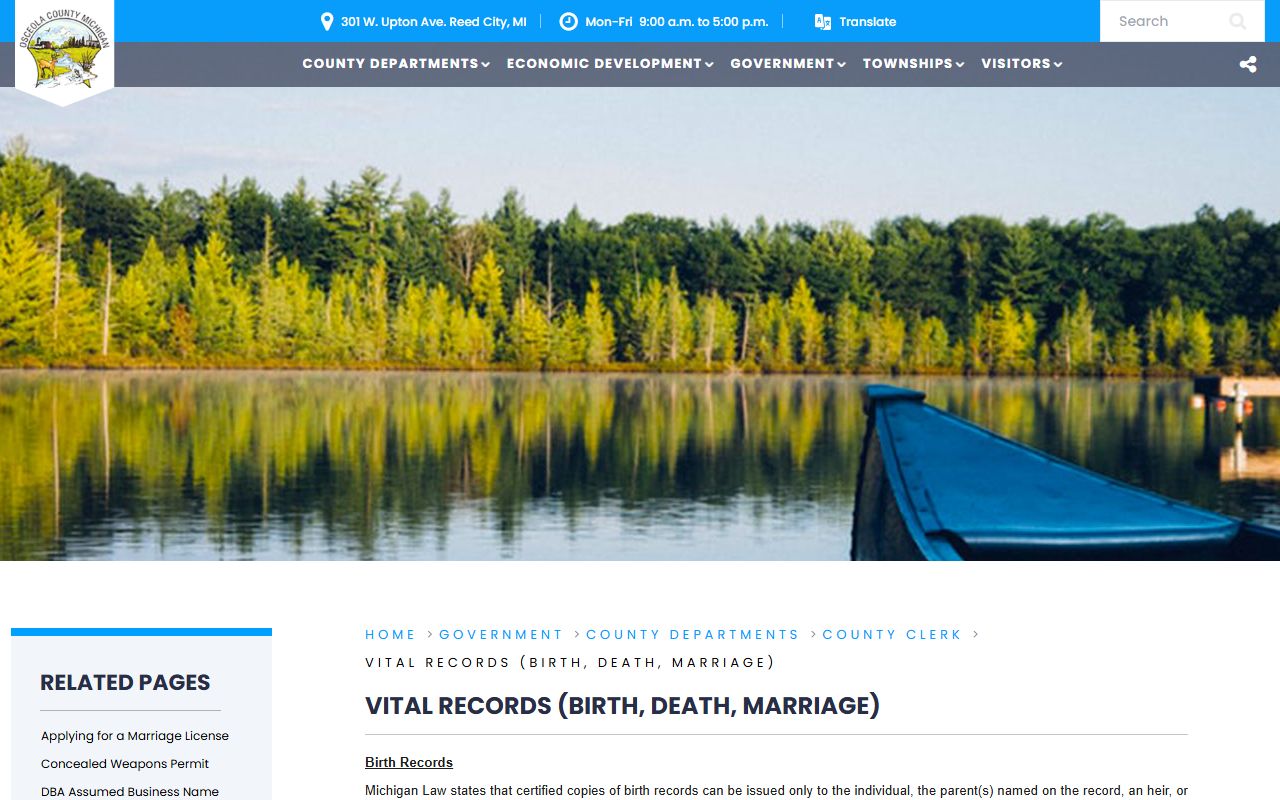
The page links two official ordering channels. Certified copies go through Official Records Online, which handles birth, death, marriage, and judgment of divorce certificates. A second link, Fidlar, lets users search for a death record or marriage record and apply for a marriage license. Details about marriage filings also appear on the county marriage and divorce records resource.
How to Request a Certified Copy
Requesting a certified copy from the Osceola County Clerk follows a short, clear path. You can order online, mail your request, or visit the first-floor office in Reed City. The steps below match the channels the county describes. Gather your details first so the clerk can find the record on the first try.
- Identify the record you need, such as a certified birth, death, marriage, or judgment of divorce copy, and confirm the event was recorded in Osceola County.
- Choose your channel. Order online through Official Records Online, or contact the clerk at (231) 832-3261 or clerk@osceolacountymi.gov to request by mail or in person.
- Provide the names, dates, and any case or certificate details that help staff locate the exact record.
- Pay the fee. A certified vital-record copy is $12 for the first copy and $6 for each additional copy of the same record.
- Pick up the copy at the office, or wait for it to arrive by USPS First Class Mail or Federal Express for an added charge.
Note: Order the certified version whenever an agency, employer, or court asks for proof, since uncertified copies are often rejected for official use.
Osceola County Criminal and Civil Name Searches
Osceola County does not run a single free online court-record database. For 49th Circuit Court criminal and civil records, the County Clerk performs a paid name search instead. Staff check the court records for the name you provide and report what they find. The county name-search page spells out the process and the cost.
The fee is $5 for each name searched. If a record turns up and you want a copy of the Register of Actions, which is the chronological docket history of a case, the office adds $1 per page. Because the request is written or in person rather than an online form, it helps to include as much detail as you can. A date of birth, a rough filing year, and whether the matter is criminal or civil all speed up the search.
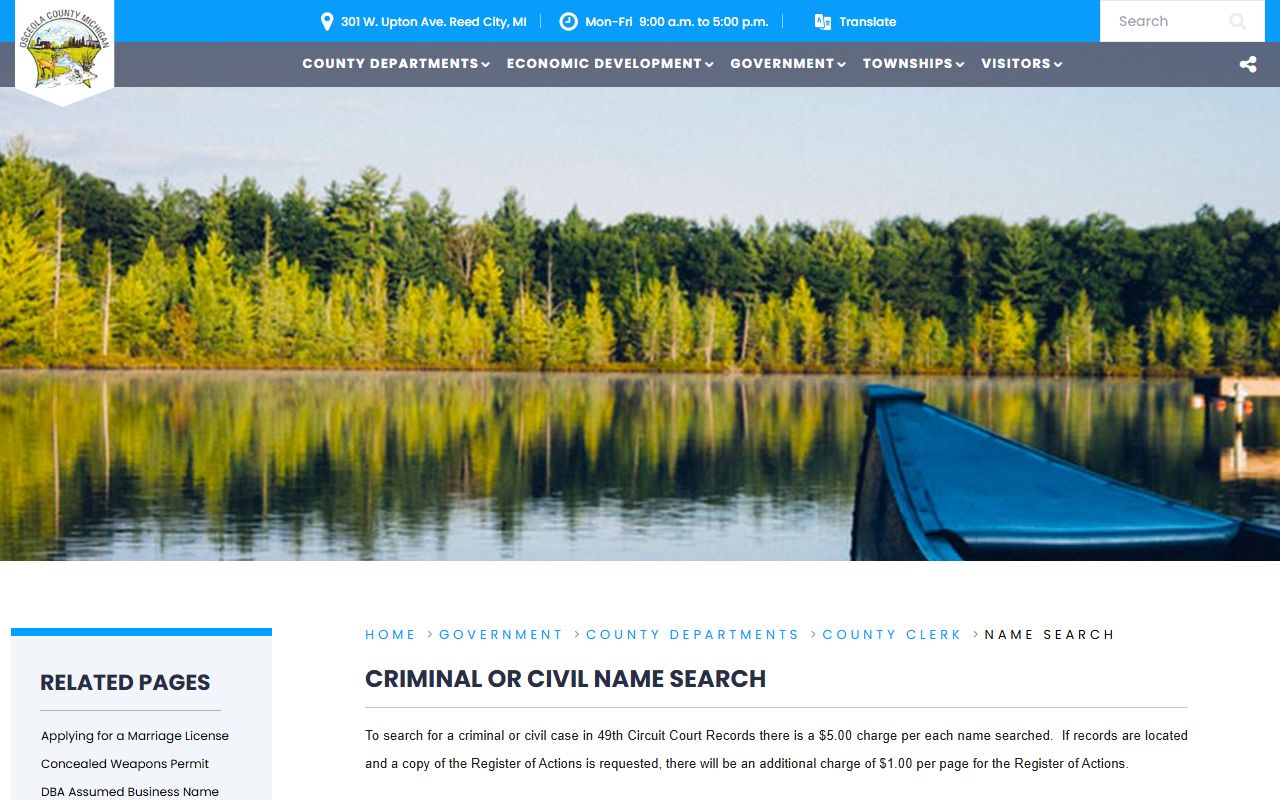
The table above reflects the counter where these searches are handled. The field guide below shows what to give the clerk when you ask for a criminal or civil name search.
| Field | Type | Required | Notes |
|---|---|---|---|
| Name to be searched | Written or in-person request | Yes | Search covers a criminal or civil case in 49th Circuit Court records. |
| Record type | Request description | Recommended | State whether the matter is criminal or civil. |
| Copy of Register of Actions | Request option | Optional | Add $1 per page if a record is found and a copy is requested. |
| Fee payment | Payment | Yes | $5.00 charge per each name searched. |
Osceola County Clerk Fees
The Osceola County Clerk publishes a clear fee list for its most common services. Certified copies, filings, permits, and searches each carry a set charge. Knowing the amount ahead of time helps you bring the right payment. The full schedule from the county fee page appears below.
The county keeps the current list on its official Osceola County Clerk fee page. Filing fees for divorce and civil actions run higher than copy fees because they open a new circuit court case. Veterans pay nothing for a certified copy of a DD214 discharge record.
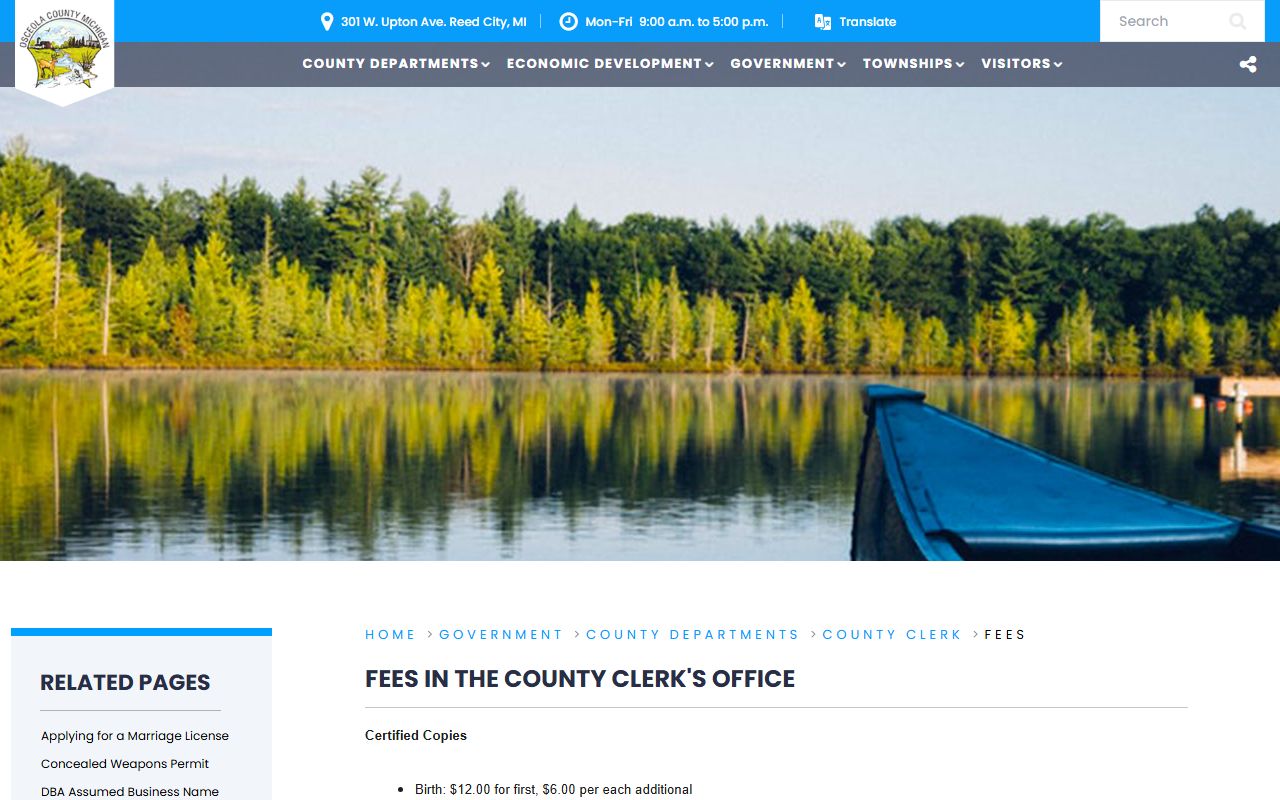
The fee image mirrors the counter posting for these services. Amounts can change, so confirm with the office before mailing a payment.
| Item | Amount |
|---|---|
| Certified birth copy | $12 first copy, $6 each additional |
| Certified death copy | $12 first copy, $6 each additional |
| Certified marriage copy | $12 first copy, $6 each additional |
| Summons and complaint filing | $175 |
| Divorce with children | $255 |
| Divorce without children | $175 |
| Child support motion | $60 |
| Custody or parenting time motion | $100 |
| Marriage license application | $20 |
| Marriage license, out-of-state applicants | $30 |
| Assumed business name (DBA) | $10 |
| CPL application, new or renewal | $115 |
| DD214 (veteran discharge) | Free |
| Notarization of a document | $5 |
| Notary application | $10 |
| Criminal search | $5 per name |
| Certified court copies | $10 plus $1 per page |
| Copies | $1 per page |
Register of Deeds and Land Records
The Register of Deeds is a separate Osceola County office, not part of the County Clerk. It handles real-property records rather than court files or vital records. Its mission is to process and preserve documents about county land under the Michigan Recording Act. If you need a deed, a mortgage, or a lien record, this is the office to contact.
Land records reach far back in the county's history. The Register of Deeds page describes an office focused on public real-property records. Documents date back to 1853, and all recorded documents are imaged and searchable by liber and page. Handwritten Grantor and Grantee indexes exist through 2003, while public terminals search Grantor and Grantee records starting in 1988.
Keeping the two offices straight saves time. Vital records and court filings go to the County Clerk, while deeds and land documents go to the Register of Deeds. The searching tools for land records differ from anything the clerk offers.
Searching Osceola County Land Records
Online land searches are available for the Register of Deeds through a hosted portal. The Register of Deeds searching page notes that online land records run from 1988 to current. Older documents remain accessible through the office, since the imaged collection reaches back to 1853.
The land-search system runs on a Tyler-hosted platform with a required disclaimer screen. The Tyler land-search disclaimer states the data is for private, noncommercial public use, and it prohibits automated searches. Users are urged to try every possible spelling variation of names and other criteria. The index works like a library card catalogue and should not be treated as legal proof of the underlying document.
Because names change spelling over decades, patient searching pays off here. When a record predates 1988, or when the online index is unclear, contact the Register of Deeds staff directly for help pulling the imaged document.
Court Records, FOIA, and the Osceola County Clerk
People often assume the Freedom of Information Act covers every county record. That is not the full picture in Osceola County. County Administration serves as the county FOIA coordinator for general public records, such as many sheriff and administrative files. Written FOIA requests must describe the record clearly and include contact details, and a public body may charge processing fees.
Court records follow a different rule. The Michigan Attorney General explains that the judiciary, including county clerk employees acting as circuit-court clerk, is excluded from the FOIA definition of a public body. Court files are instead accessed under the Michigan Court Rules, chiefly MCR 1.109 and MCR 8.119. Those rules define what a court record is and protect sensitive personal information like Social Security and driver's license numbers.
Note: For a circuit court case file, use the clerk's name search or the court rules rather than a FOIA request, since the judiciary is outside FOIA's scope.
The practical takeaway is simple. Start with the office that created the record. For circuit criminal, civil, and divorce records, contact the Osceola County Clerk or check statewide court search tools. For county administrative records, use the FOIA path through County Administration. Matching the record to the right office and the right law is the fastest way to get what you need.