
Criminal Court Records in Osceola County
A criminal court record is the full case file a court opens once someone is charged with a crime. It is not the arrest report and it is not a jail booking sheet. It is the running account of the case itself. The file grows as the case moves, gathering the charging document, each hearing notice, every motion and order, the plea, the verdict, and the final sentence. In Osceola County, the courts and the clerks who serve them keep these records. The County Clerk holds felony case files for the 49th Circuit Court, while the 77th District Court keeps its own misdemeanor and lower-level case files.
Two trial courts share the criminal work. The 77th District Court handles misdemeanors punishable by not more than one year, from arraignment through trial and sentencing. Felony cases begin in the same District Court, which handles the arraignment, bail, and the preliminary examination. If the case is bound over, it moves up to the 49th Circuit Court, shared with Mecosta County, for plea or trial and sentencing. The Prosecuting Attorney authorizes and prosecutes the charges. For the charges themselves, the Osceola County arrest and court charge records page goes into more detail.
Charges in a county criminal case are authorized by the Osceola County Prosecuting Attorney, a fact laid out on the office's Prosecuting Attorney department page.

Anthony Badovinac serves as the county's chief law enforcement officer and decides which state felony and misdemeanor charges are filed, which then open the court case record.
How to Search Osceola County Criminal Court Records
Osceola County does not run one countywide criminal case database. Instead, a search blends a state case portal, a paid clerk name search, and a statewide criminal history system. Docket-level information for participating courts can be found through MiCOURT Case Search, which may show civil, traffic, criminal, domestic, and probate cases depending on the court. For 49th Circuit Court felony files, the County Clerk performs a paid name search rather than offering a self-service database.
- Open MiCOURT Case Search and pick the court, such as the 49th Circuit Court or the 77-2 District Court.
- Search by defendant name or, if you have it, the case number in the Michigan year-plus-two-letter-suffix format.
- Narrow the results by case type and filing date to separate common names.
- Open the matching case to read the register of actions, the plea, and the disposition.
- Ask the County Clerk or the correct District Court division clerk for a certified copy when a signed record is needed.
For a Circuit Court criminal file, the County Clerk charges $5 per name searched, plus $1 per page if you want a copy of the register of actions. Certified court copies run $10 plus $1 per page. District Court criminal matters go through the criminal division clerk, reached at (231) 832-6155, option 1. For a statewide picture, the Michigan State Police run the Internet Criminal History Access Tool, known as ICHAT, which returns public conviction history from across the state. ICHAT does not include warrant information or suppressed records, so it is not a substitute for pulling the court's own file.
Stages of an Osceola County Criminal Case
A criminal case moves through set stages, and each one leaves a mark in the court record. Reading the file in order is the easiest way to see where a case stands. A felony travels farther than a misdemeanor, because it starts in District Court and can move up to Circuit Court. The docket, or register of actions, lists these events by date so anyone can trace the path from the first charge to the sentence.
Case flow: Charges Filed › District Court Arraignment › Preliminary Examination › Bindover › Circuit Court › Plea or Trial › Disposition › Sentencing
| Stage | What Happens |
|---|---|
| Charges Filed | The Prosecuting Attorney authorizes a complaint that names the defendant and lists each charge and statute. |
| District Court Arraignment | The defendant is told the charges in the 77th District Court, enters a first plea, and the court sets bail or bond conditions. |
| Preliminary Examination | For a felony, the District Court decides whether there is enough proof for the case to go forward. |
| Bindover | If the proof clears the bar, or the exam is waived, the felony is transferred up to the 49th Circuit Court. |
| Plea or Trial | The case ends in a plea or is tried before a judge or jury, with motions and hearings recorded along the way. |
| Disposition | The record shows the outcome, such as guilty, not guilty, or dismissed. |
| Sentencing | After a conviction, the court imposes jail, probation, fines, costs, or restitution and enters the terms in the file. |
Note: A misdemeanor stays in the 77th District Court through sentencing, so it will not show a bindover or a Circuit Court transfer in the record.
What an Osceola County Criminal Court Record Shows
Michigan Court Rule 1.109 defines a court record as the information created by the court or filed with it. A criminal case file pulls together many fields, and each one tells part of the story. The caption lists the court, the parties, and a case number built from the filing year and a two-letter case-type code. Below the caption, the register of actions logs every filing and event in date order. The table below breaks down the fields you are most likely to read in an Osceola County criminal file.
| Field | What It Shows |
|---|---|
| Case Number | A year prefix plus a two-letter case-type suffix that identifies the file and the court. |
| Defendant | The name of the person charged, with protected personal details redacted. |
| Charges | Each offense, the statute cited, and its classification as a felony or misdemeanor. |
| Plea | The defendant's formal response, such as guilty, not guilty, or no contest. |
| Hearings | The date, time, courtroom, and type for arraignment, exam, motions, and trial. |
| Disposition | The case outcome, such as convicted, acquitted, or dismissed. |
| Sentence | Jail or prison time, probation, fines, costs, and any restitution ordered. |
Some data stays out of the public copy. Under MCR 1.109, a person's date of birth, Social Security number, driver's license or state ID number, passport number, and financial account numbers are protected and kept off public documents. The register of actions is generally the public layer, while the underlying document images may take a clerk request, a fee, or an in-person visit to pull.
Charges vs. Convictions
Being charged is not the same as being convicted. A charge is an accusation that opens the case, while a conviction is the finding of guilt at the end. An Osceola County criminal record can show charges that were later dropped, dismissed, reduced, or that ended in an acquittal. Reading only the charge and stopping there gives a false picture. Always follow the file to the disposition before drawing a conclusion about how the case ended.
| Charge | Conviction | |
|---|---|---|
| Stage | Accusation | Verdict or plea |
| Burden of Proof | Probable cause | Beyond reasonable doubt |
| Public Record | Yes | Yes |
Reading Dispositions and Sentences
The disposition is the line that tells you how a case ended. Common entries include guilty, not guilty, dismissed, and no contest, which the record may abbreviate as nolo. A guilty plea and a guilty verdict both count as convictions, though they reach that point in different ways. A dismissal means the case closed without a conviction. Some cases resolve through deferred or delayed arrangements, where a plea is held back and the charge may be reduced or removed if terms are met.
The sentence follows a conviction and spells out the penalty. In an Osceola County file, expect to see jail time in the county facility for misdemeanors, prison for many felonies, probation supervised in the community, and money terms such as fines, court costs, and restitution to a victim. Probation entries often list conditions, review dates, and any violation filings. When a defendant is sent to state prison, the sentenced status can also be tracked through the Michigan Department of Corrections OTIS offender search, which is separate from the county case file and does not cover county jail stays.
For legal research beyond the local docket, the free CourtListener database collects court opinions and some federal docket material.
CourtListener is a useful free reference for reading how courts have ruled, but it is not the official Osceola County record and should not replace the court's own file.
Sealed vs. Set Aside in Michigan
Michigan does not use the word expunged in its statutes. The state term is set aside, which many people still call expungement in everyday speech. A sealed record is hidden from ordinary public view but still exists in the file. A set-aside conviction goes further: it is removed from public criminal history, though courts and law enforcement may keep limited access under the statute. The adult set-aside process lives in MCL 780.621, which defines who may apply and which offenses qualify.
The full set-aside statute spells out the eligibility limits and steps in detail.
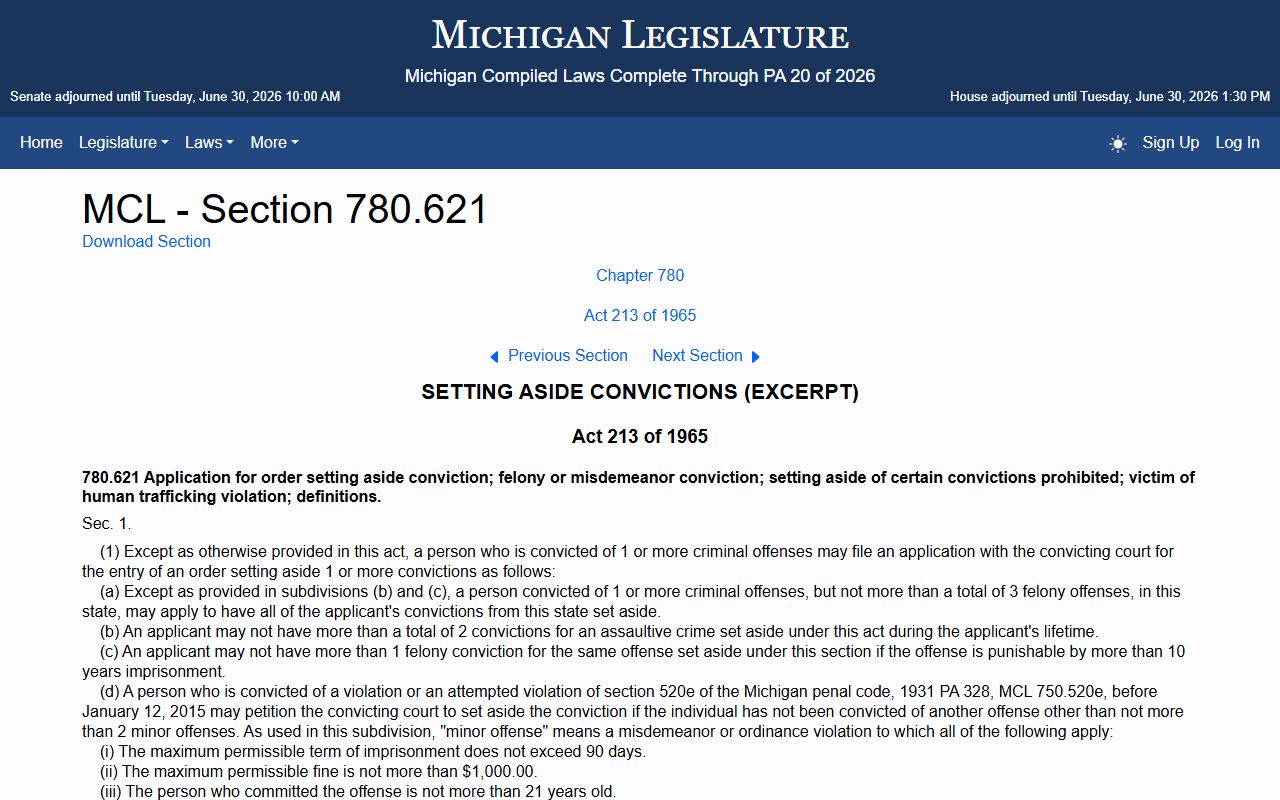
Reading MCL 780.621 directly is the surest way to check whether a specific Osceola County conviction can be set aside and how many prior convictions the law allows.
| Sealed | Set Aside | |
|---|---|---|
| Visibility | Hidden from public view, file still exists | Removed from public criminal history |
| Law Enforcement | Limited access retained | Nonpublic access may remain under statute |
| Michigan Basis | Court order or nonpublic status under court rules | MCL 780.621 and the Clean Slate laws |
Some records are now set aside automatically. Under Michigan's Clean Slate program, the Michigan State Police Clean Slate page explains that certain misdemeanors of 92 days or less, kept only in court case management, may be set aside by the court seven years after sentencing.
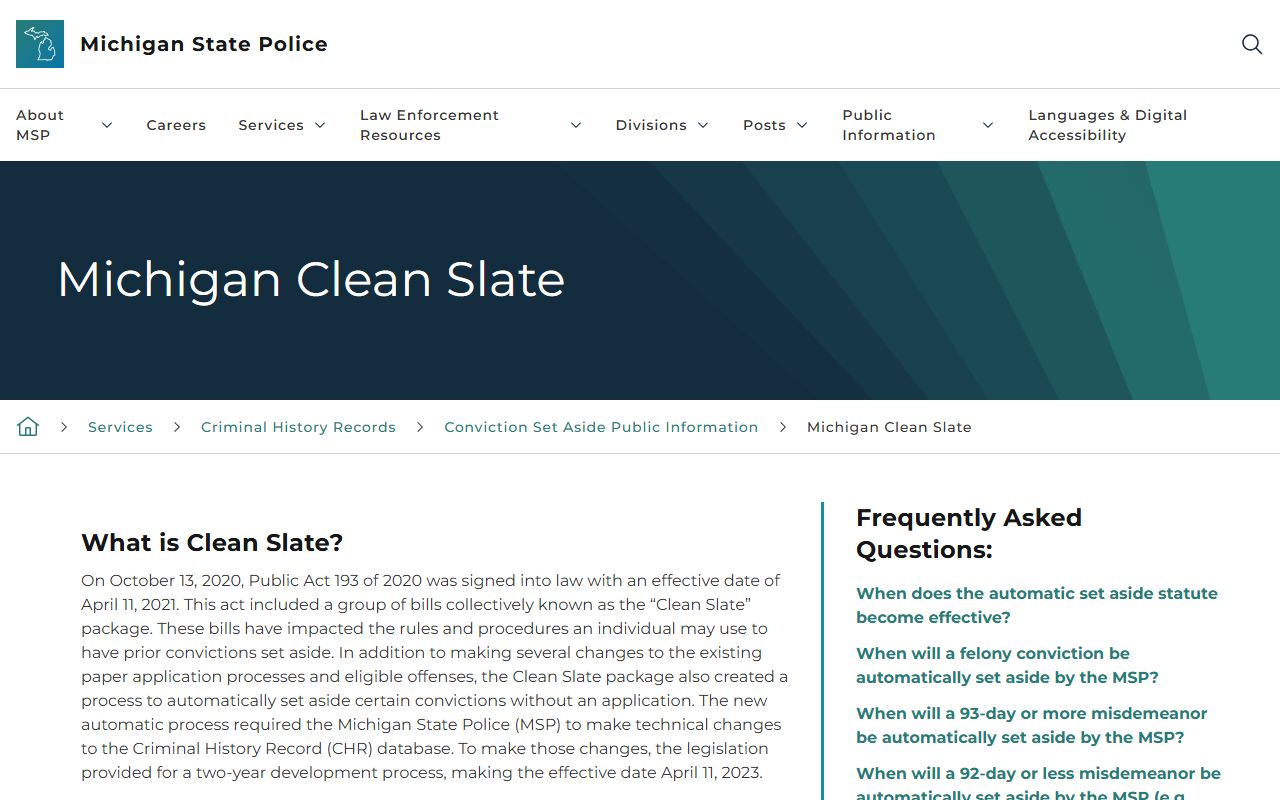
The Clean Slate guidance helps residents see whether a past Osceola County conviction may clear on its own or whether an application is still required.
Public Access to Osceola County Criminal Court Records
Most criminal case files in Michigan are open to the public, but they are governed by court rules rather than the state Freedom of Information Act. The Michigan Attorney General notes that the judiciary, including county clerk staff acting as circuit-court clerk, is excluded from the FOIA definition of a public body. That means a criminal file is accessed through Michigan Court Rules, not a FOIA request. Start with the court that created the record, then use MiCOURT or the County Clerk name search where available.
Key Statutes:
Michigan Court Rule 1.109 - Defines court records, case-number format, and the personal details that must stay off public filings.
Michigan Court Rule 8.119 - Governs how trial courts keep, manage, and release court records and reports.
County sheriff, jail, and incident records follow a different path and do go through the county FOIA coordinator in County Administration. For a state-level conviction history, ICHAT remains the public search tool run by the Michigan State Police under MCL 15.231, the FOIA policy statement, which sets the general open-records framework for the records that FOIA does cover.
Background Check Considerations
A casual name lookup is not the same as a formal background check. Employers, landlords, and licensing bodies that make decisions about a person must follow the federal Fair Credit Reporting Act and use a regulated screening company. A quick MiCOURT search or an ICHAT report can answer a personal question, but it should not drive a hiring or housing decision on its own. Records can also be incomplete, and a set-aside conviction may no longer appear, so verify anything important against the court's own certified file.
Important: This website is not a consumer reporting agency under the Fair Credit Reporting Act, and its records may not be used for employment, tenant, credit, or insurance screening.
Restricted Criminal Court Records in Osceola County
Not every criminal record is open to the public. Some are closed by statute, and others are held back while a case is active. Juvenile matters are the clearest example. The Probate and Family Court handles delinquency and juvenile probation, and MCL 712A.28 keeps juvenile court records open only by court order. A person seeking access should ask the Juvenile Register whether they qualify rather than assume the file is public.
Set-aside convictions also drop out of ordinary public view once granted. Beyond those, protected personal identifiers under MCR 1.109 are redacted from public copies, and warrant details are not returned by ICHAT. The criminal case file also does not track jail custody or active warrants, which sit in separate systems. For the wider set of case files across every court, the Osceola County court records page brings the categories together.
Note: When a record appears missing, it may be sealed, set aside, juvenile, or simply still open, so confirm its status with the clerk before assuming no record exists.